OEM sheet metal manufacturing · Dongguan, Chinasales01@xinghaoxin.comTalk to our team ↗
Electrical Enclosures
CUSTOM XHX ENCLOSURE

Electrical Enclosures

Custom metal housings for electrical equipment, panels and integrated assemblies.

  • Free DFM review
  • From 1 piece
  • ISO 9001 quality system
  • Quote with findings

Built to your drawings · OEM / ODM · Dongguan, China

ELECTRICAL & ELECTRONIC ENCLOSURES

Enclosures that fit
the equipment exactly.

This is the widest category we build, and the one where the enclosure is least interesting to the buyer and most important to the project. Nothing about an electrical enclosure is difficult on its own; the difficulty is that every dimension has to agree with equipment somebody else designed.

The enclosure is a mechanical interface

An electrical enclosure is where a designer’s component list becomes a physical object: DIN rail spacing, mounting hole patterns, gland positions, door swing and clearance for a cable bend radius. If any one of those is a few millimetres out, the fitter discovers it during installation and the enclosure becomes the problem rather than the enclosure.

We work from the component layout, not a catalogue size

Rather than picking the nearest standard box, we take the equipment dimensions and the available space and build to those. That is often cheaper than adapting a standard enclosure, because you are not paying for volume you cannot use or fighting clearances you did not need.

Prototype first, then repeat

Most projects start with a single unit so the fit can be proven before committing to a batch. Because the approved drawing and the first-off inspection report stay with the project, the tenth batch is built to the same reference as the first.

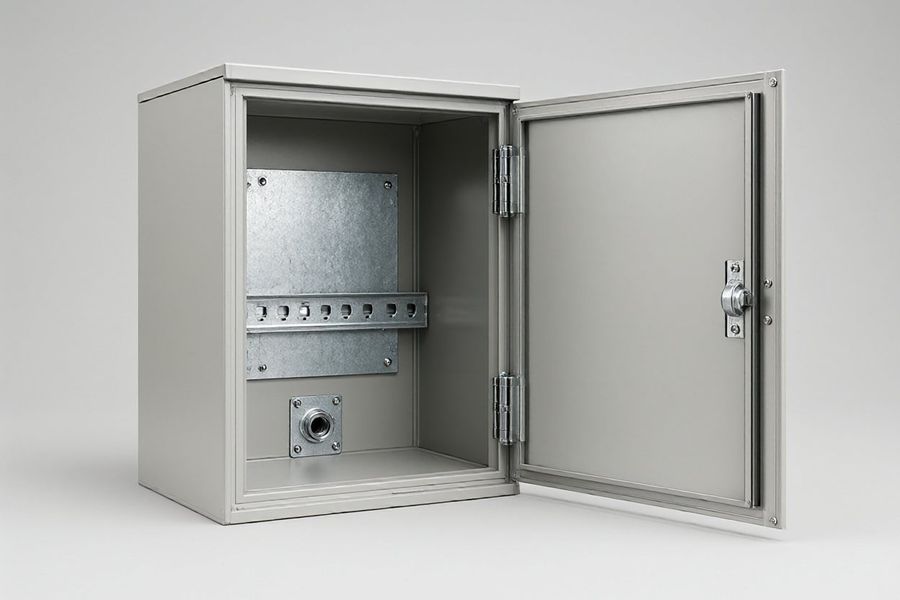
Electrical enclosure with door open showing DIN rails

MATERIAL SELECTION

Choosing the material
for the real exposure.

The grade is decided by where the enclosure lives and how it is cleaned — not by what is cheapest on the day.

Cold-rolled steel (SPCC) with powder coat

The standard choice for indoor equipment: rigid, dimensionally stable, and cheap to form accurately. Powder coated in the colour you specify, which also gives a wipeable surface for a control room or a workshop.

Best for: indoor control panels, machine-mounted enclosures, lab equipment

Galvanized steel (SGCC)

Chosen where the enclosure will be drilled or cut during installation and the cut edges need protection without a second coating step. Common for junction and marshalling boxes.

Best for: junction boxes, marshalling panels, field-modified enclosures

Stainless 304

For wash-down, food-adjacent and clinical environments where painted steel would eventually chip and corrode at the damage point. Supplied brushed or abrasive-blasted.

Best for: food, pharma, clinical, wash-down areas

Aluminium

Used for chassis and instrument enclosures where weight or heat conduction matters more than cost. Anodizing gives a durable finish without a paint coating.

Best for: chassis, instrument cases, portable equipment

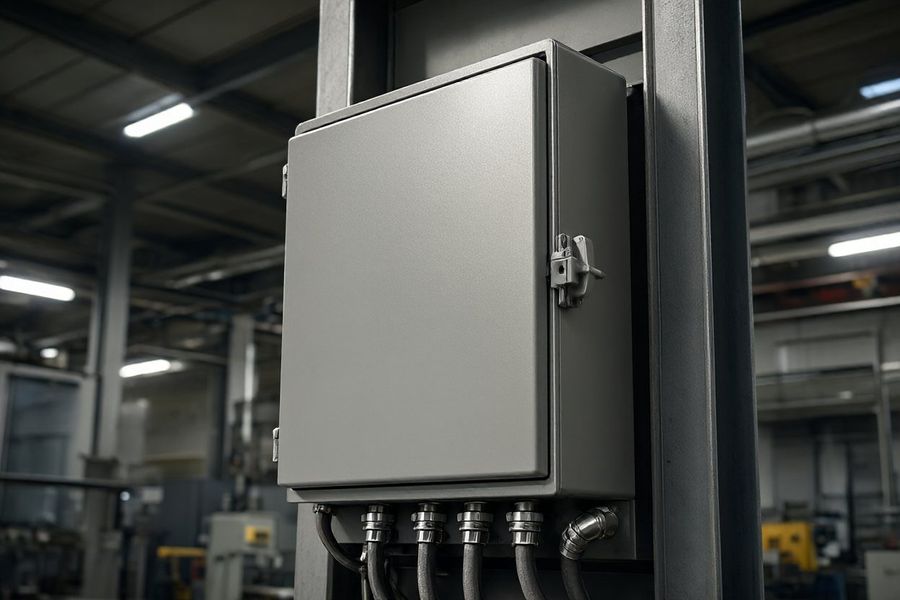
Electrical enclosure mounted on industrial machinery

From the workshop — the same drawing-led process on every build.

WHERE IT IS INSTALLED

Applications and
what drives each one.

The same product behaves differently depending on where it goes. These are the installations we build for and the constraint that shapes each.

01

Machine-mounted control enclosures

Enclosures bolted directly to production machinery, where vibration and coolant are normal conditions. Mounting points are designed into the frame and the door hardware is specified to stay closed under vibration.

02

Building services and equipment rooms

Distribution, metering and BMS panels in equipment rooms. The constraints are usually access and cable routing rather than environment, so door swing and gland layout drive the design.

03

Laboratory and test equipment

Instrument enclosures where appearance and cleanability matter as much as protection. Brushed stainless or a fine-texture powder coat, with careful attention to weld finishing on visible faces.

04

Junction and marshalling boxes

Small enclosures used in quantity, where consistency between units matters more than any single one. Laser-cut patterns and press-brake forming give repeatability without tooling.

QUESTIONS

What buyers ask
about this product.

Can you work from a component list instead of a finished drawing?

Yes. Send the component dimensions, the layout you want and the space available, and engineering produces the enclosure drawing for you to approve before anything is cut.

Do you fit the internal components?

We can supply the shell alone, or assembled with panels, rails, terminals and agreed sub-assemblies fitted. Tell us where the scope ends in the RFQ.

What tolerance do you hold?

Laser cutting positions to ±0.01 mm. Formed and welded assemblies are held to the tolerances marked on your drawing, and the critical dimensions are confirmed on the first-off sample.

What is the smallest quantity?

One piece, with no tooling charge. Most projects prove the fit with a single unit before placing a batch.

How do you handle a design change after the first batch?

The approved drawing is revised and a new first-off sample is produced against it. We do not run a batch against a drawing that has changed without confirming the change first.

START A PROJECT

Send the drawing.
Get the findings back.

Engineering reviews manufacturability and returns the open questions with the quotation — before you commit to production.