Carbon steel (SPCC / CRS)
The workhorse: formable, weldable, dimensionally stable and the cheapest option for most parts. Powder coated or plated depending on the service environment.
Best for: brackets, chassis, covers, general fabrication
 Request a quote ↗
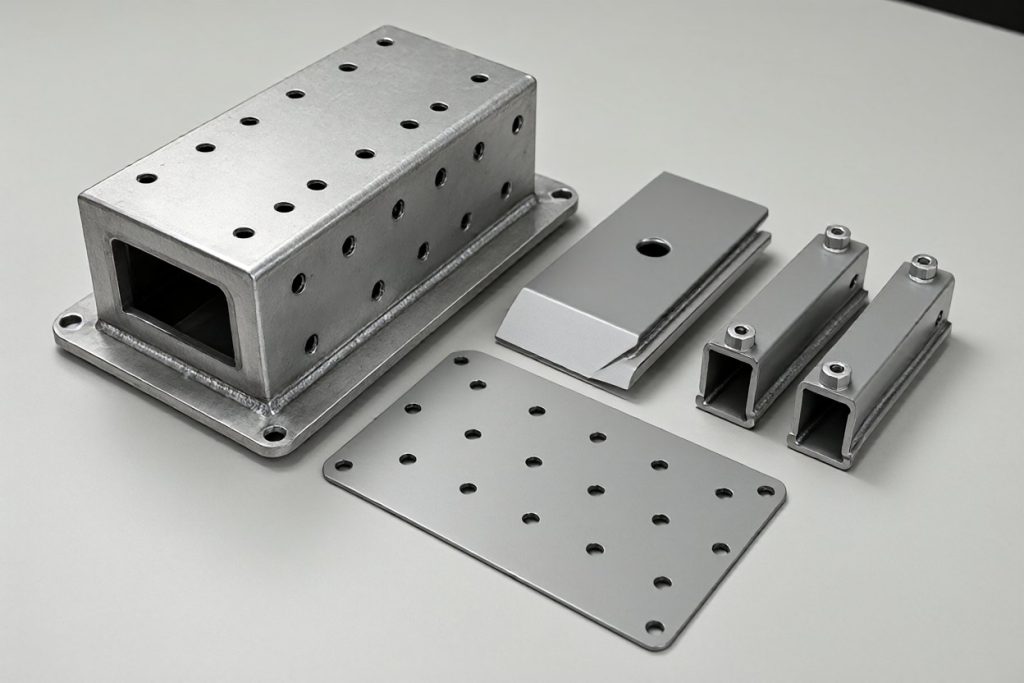
Enclosures, chassis, covers and assemblies built from your drawings.
Built to your drawings · OEM / ODM · Dongguan, China
CUSTOM SHEET METAL ENCLOSURES
Some projects do not fit a product family at all. A chassis, a cover, a bracket, a guard or a fabricated assembly that exists only in your drawing. This is the work we do most of, and the process matters more than any product name.
For a custom part there is no catalogue to refer to — the drawing is the whole specification. That makes the first review the most valuable step in the project, because it is where ambiguities are found and tolerances are agreed while changing them is still cheap.
A drawing that cannot be formed in one hit, or that needs a weld in a place that will distort, costs money in production. We return those findings with the quotation, along with what each one changes, so the decision stays with you rather than being quietly absorbed into the price.
A large share of our work starts at a single unit. There is no tooling charge and no volume commitment, because the process is the same whether we run one part or five hundred — only the quantity in the batch changes.
MATERIAL SELECTION
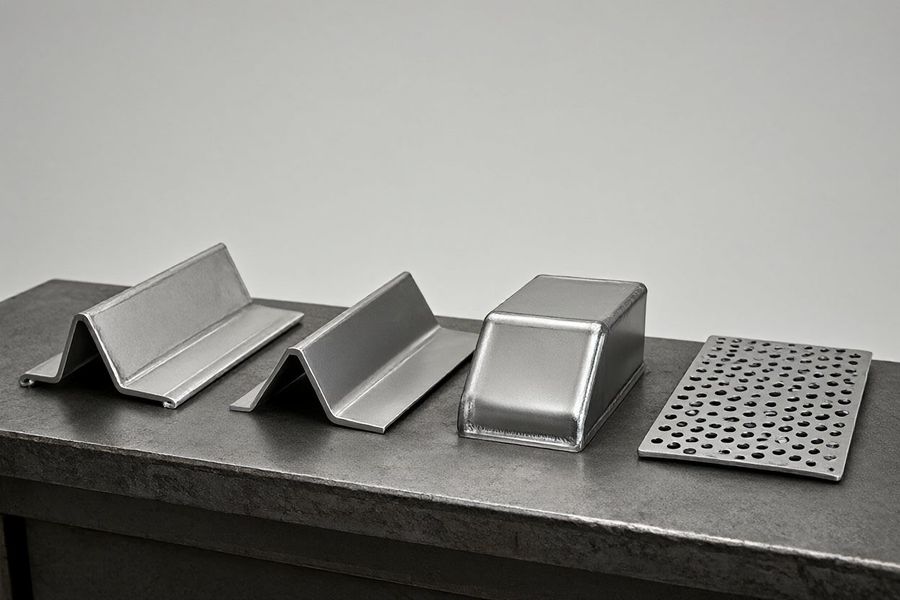
The grade is decided by where the enclosure lives and how it is cleaned — not by what is cheapest on the day.
The workhorse: formable, weldable, dimensionally stable and the cheapest option for most parts. Powder coated or plated depending on the service environment.
Best for: brackets, chassis, covers, general fabrication
Chosen when the part will be cut or drilled after fabrication and the edges need protection. Common for parts that are installed outdoors or modified during installation.
Best for: outdoor brackets, field-modified parts
Specified for corrosion resistance, cleanability or appearance. 304 for general use, 316 for chlorides. Forming stainless takes more force and more springback compensation than carbon steel, which is why the bend allowance is confirmed on the first-off sample.
Best for: food, medical, marine, architectural parts
Used where weight matters, or where the part needs to conduct heat. Soft enough to form easily but with enough strength for structural brackets when the alloy is chosen correctly.
Best for: lightweight brackets, heat sinks, portable equipment
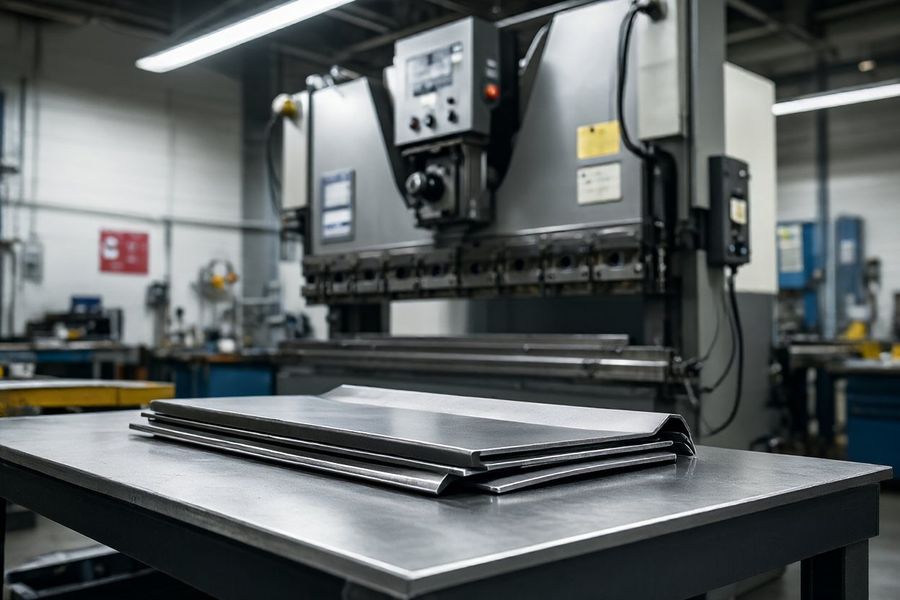
From the workshop — the same drawing-led process on every build.
WHERE IT IS INSTALLED
The same product behaves differently depending on where it goes. These are the installations we build for and the constraint that shapes each.
01
Frames that hold PCBs, drives or mechanical assemblies inside a larger machine. The tolerances are usually tight and the part is rarely seen, so function dominates the design.
02
Exterior parts where appearance and safety both matter. Weld finishing and coating consistency are specified on visible faces, and edge treatment matters because a guard is something people touch.
03
Small parts bought in quantity, where consistency between units is the main requirement. Laser cutting and press-brake forming give repeatability without dedicated tooling.
04
Where several parts are welded or fastened into a single unit before shipping. The assembly is built on a jig to hold alignment, and the first-off sample confirms the assembly rather than just the parts.
WHAT IS CHANGING
Design requirements in this category are moving. These are the shifts we see in drawings arriving today, and what each one does to the enclosure.
Buyers increasingly want the prototype made the same way as production, so validation results carry over. That argues for laser cutting and CNC forming from the start rather than a shop-made one-off.
STEP models are becoming the primary deliverable and 2D drawings secondary. That speeds up programming but shifts the burden of tolerance definition — a model without a tolerance callout is not a complete specification.
Order patterns are moving away from large annual batches toward smaller, more frequent releases. Enclosure suppliers that can run small batches economically are being favoured over those that need volume to be viable.
Dimensional reports, material certificates and traceability are being requested on custom parts, not just on catalogue items. That changes what “finished” means on the production side.
QUESTIONS
STEP, STP, DXF, DWG and PDF, plus reference images. A hand sketch with the key dimensions is enough to start the DFM conversation.
That is the normal starting point. Engineering returns what is still open and what each open item changes, so you close them before committing to production rather than after.
Yes. Send the sample and we measure it and produce a drawing for your approval before quoting production.
Yes. Send yours and we return a countersigned copy, or ask for ours. Drawings are used only to build your parts and are never reused for another client.
One piece, with no tooling charge. Repeat orders run on the same process, so nothing changes when the quantity increases.
START A PROJECT
Engineering reviews manufacturability and returns the open questions with the quotation — before you commit to production.
SEND DRAWINGS
Share the drawings or the dimensions you have. Engineering reviews them and returns the findings with the quotation — usually within one working day.