30 t
Turret press capacity. Sets the maximum material thickness for a given hole size.
 Request a quote ↗
CNC STAMPING
CNC turret punching for repeat panels, mounting patterns and vent arrays. Once a pattern repeats, the turret press is faster and cheaper per hole than tracing each one with the laser — and the last hole is identical to the first.
30 t turret · up to 6 mm · ±0.1 mm
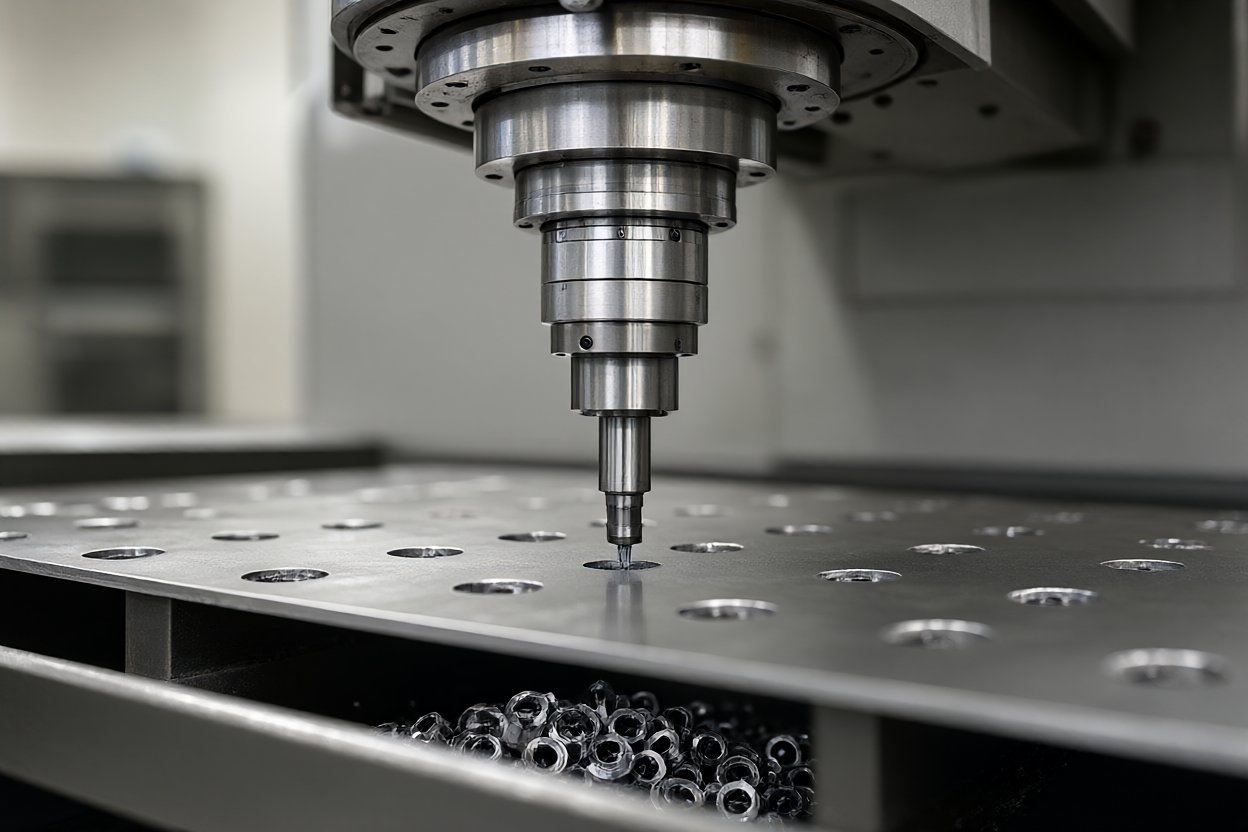
TURRET PRESS CAPACITY
The turret press is not a replacement for the laser — it is the faster answer to one specific shape of job. These four numbers describe where that line falls.
Turret press capacity. Sets the maximum material thickness for a given hole size.
Working thickness in mild steel. Above that, hole quality falls away and the laser takes over.
Hole position across a panel, held by the machine and the stops rather than by operator judgement.
Standard turret tooling carries no setup charge. Dedicated press tooling is quoted only where a shape needs it.
HOW TURRET WORK IS SPECIFIED
Turret punching leaves a different edge and a different set of constraints from a laser cut. Both are stated here so the choice between them is a decision rather than a default.
A rotating turret carries a range of round and shaped tools — rounds, squares, rectangles, obrounds, louvers and cluster tools for vent arrays. A shape already in the turret costs nothing to run; anything else is a tooling item.
A round hole should not be smaller than the material thickness, and ideally not smaller than about 1.2 times it, or the tool loads unevenly and wears on one side.
A sheared edge is cut rather than melted: clean and square, with a slightly rounded entry edge and a small burr on the exit side. On a visible face the entry side goes outward.
Vent louvers, locating lips and bridges can be formed in the same setup as the turret work. That removes a separate forming operation and keeps the feature aligned to the holes around it.
Openings larger than the largest tool are produced by overlapping strokes around the profile. That leaves a slight scallop on the edge unless a finishing pass is run, so very large cut-outs usually go to the laser instead.
The real advantage on a repeat order: every panel is produced against the same stops and the same toolpath file, so hole position does not drift across a batch the way it can across many separate laser setups.
Sheared edges are deburred before coating. On a pattern with many small holes this is a real operation and is included rather than assumed.
One-off parts, large openings, tight internal corners, and anything above the thickness limit. Cutting and turret work sit in the same building, so the choice is made per job rather than per supplier.
FROM TOOLPATH TO PANEL
The cost advantage of the turret press comes from doing everything in one setup. These are the steps that setup goes through.
01
The tools the toolpath calls for are loaded into the turret. Where a pattern uses a cluster tool, several holes are produced per stroke instead of one.
02
The machine toolpath positions the panel against the stops for each hit. Pattern origin and rotation are set here, which is what makes two panels interchangeable.
03
The first panel is checked for hole position, orientation and edge quality before the batch runs. A pattern rotated by 90° is obvious on one part and expensive on fifty.
04
The run proceeds without further setup. Panels are deburred, then move to forming or coating depending on the part.
THE TOOLING DECISION
Almost everything runs on standard turret tooling at no setup charge. Occasionally a part needs a shape the turret does not carry — a specific louver profile, a custom locating lip, a cluster pattern repeated hundreds of times per panel.
In that case a dedicated tool is quoted as a one-off item, and the decision is arithmetic: the tool cost against the per-hole time it saves across the order quantity. Below a certain volume the answer is to run standard tooling and accept the slower cycle.
That comparison is made before the quotation, and if the tooling does not pay for itself over your quantity, we say so rather than adding it as margin.
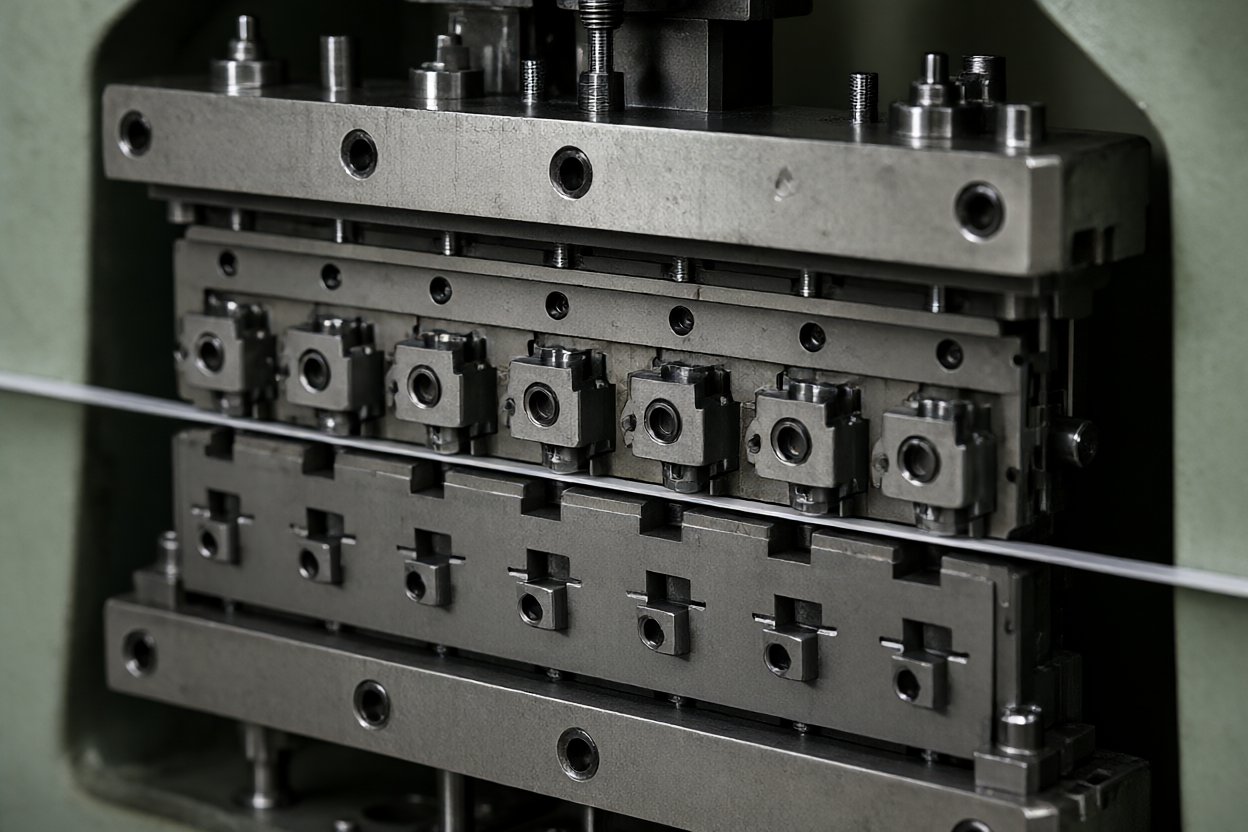
NEXT STEP
Send the panel drawing with the hole pattern and the order quantity. We will say whether turret punching or laser cutting is cheaper for it.
SEND DRAWINGS
Share the drawings or the dimensions you have. Engineering reviews them and returns the findings with the quotation — usually within one working day.