OEM sheet metal manufacturing · Dongguan, Chinasales01@xinghaoxin.comTalk to our team ↗

SURFACE TREATMENT

On a steel enclosure
the coating is the corrosion system.

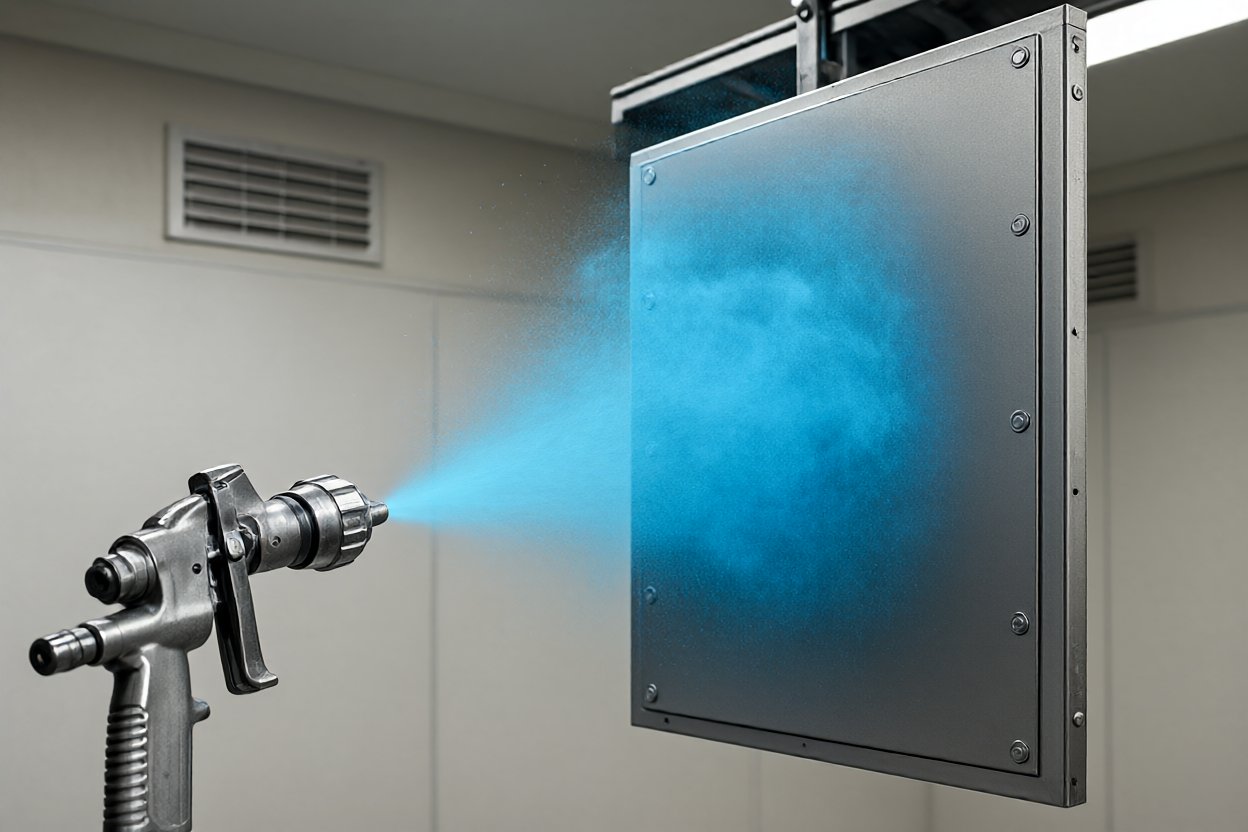
Powder coating runs on our own line, over a substrate that has been deburred and pretreated first — because a coating is only as good as what it sits on. Stainless and aluminium get a mechanical finish instead, where an applied coating is the wrong answer.

5 finishes · RAL / Pantone matched · in-house

Electrostatic powder coating gun applying a blue coat to a bare steel cabinet panel on the coating line

THE FINISH OPTIONS

Six finishes,
each for a reason.

Choosing between them is a question of exposure, cleaning regime and how the surface will be judged — not of which one looks best on a sample board.

Powder coating

The default on steel. Applied electrostatically and baked in an oven, it gives a hard, uniform coating that resists chipping far better than wet paint. Colour matched to your RAL or Pantone reference, in gloss, matt or textured.

Indoor and outdoor steel enclosures

Zinc-rich primer

A primer with sacrificial zinc in it, used under the topcoat where the steel will see moisture or occasional salt. It protects a scratch at the coating edge that a plain powder coat would let corrode underneath.

Coastal, wash-down, site-exposed

Hot-dip galvanizing

A zinc bath, subcontracted. Heavy protection with the thickest coating, at the cost of dimensional change and a rougher surface. Used on structural frames and plinths rather than on visible panels.

Ground-mounted frames, plinths

Brushed stainless

A directional brush pattern produced mechanically. Hides fingerprints better than a polished surface and can be re-brushed locally after a weld is finished, which is why it is standard on visible stainless.

Clinical, food, architectural

Abrasive blasting

A uniform matt surface with no direction. Easier to clean consistently than a brushed surface because there is no direction for residue to sit in. Also the usual pretreatment before coating stainless.

Wash-down, uniform-appearance work

Anodizing

An oxide layer grown into the aluminium rather than applied on top, so it cannot chip off. Colour range is narrower than powder coating and the finish is usually specified for its hardness.

Aluminium panels, pole-top units

HOW THE FINISH IS SPECIFIED

What to put
on the drawing.

A finish callout of “powder coat, grey” leaves almost everything undecided. These are the parameters that actually change the result.

Colour reference

A RAL number is unambiguous. A Pantone reference has to be matched to a powder equivalent, which is close but rarely exact. Where colour is critical, send a physical sample — a screen colour is not a reference.

Gloss level

Gloss, semi-gloss, matt or textured. Matt and textured hide handling marks and slight surface waviness far better than gloss on a unit that will be moved and installed. Gloss shows every imperfection in the panel underneath.

Coating thickness

Typically 60–120 µm for a decorative powder coat and higher where a zinc-rich primer sits underneath. Thicker is not automatically better: beyond a point the coating turns brittle and chips at edges instead of flexing.

Which faces are judged

State whether the inside of a cabinet matters. Coating both faces costs more and is usually unnecessary, but a partly coated interior shows bare steel at every fixing point.

Pretreatment

Degrease, deburr and phosphate before coating. Skipping it is the single most common cause of a coating that lifts at a cut edge two seasons later. It is included as standard, not as an upgrade.

Edge coverage

A laser-cut edge takes coating less evenly than a rolled edge. Where an edge will be handled, the drawing can ask for it to be deburred and rounded so the coating wraps instead of breaking at a sharp corner.

Plugging and taping

Threads, earthing points, mating faces and any datum surface have to be plugged or taped before coating, because a 100 µm coating changes a fit. Those areas are marked on the drawing, or they get coated and the fastener no longer seats.

Touch-up

A small touch-up pen matched to the colour ships with the order for damage during installation. It is not a repair for a coating defect, which is reworked before dispatch.

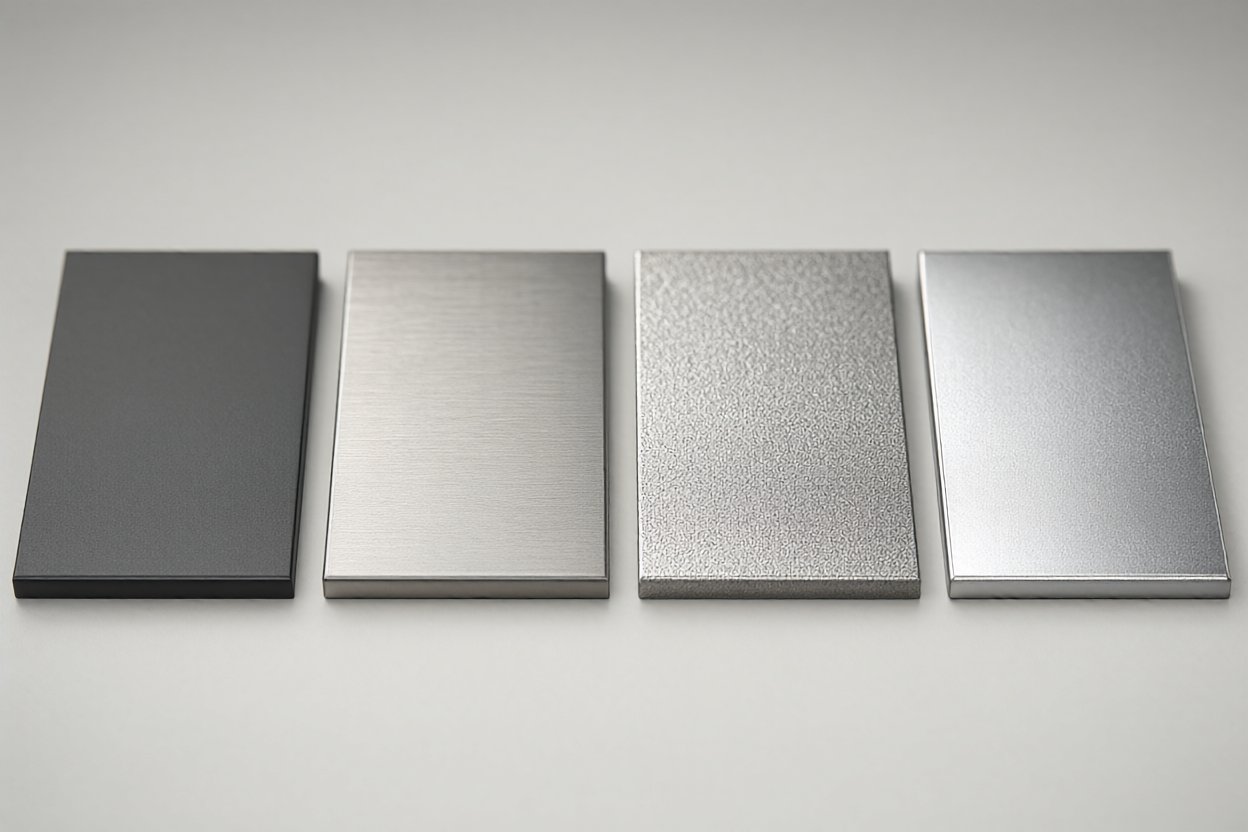
Four metal finish samples in a row: powder-coated steel, brushed stainless, abrasive-blasted stainless and anodized aluminium

APPLIED OR MECHANICAL

The right finish
is not always a coating.

On stainless steel, a powder coat is usually the wrong choice. It adds a coating that can chip, and underneath it a scratch has nowhere to go but into the metal. A brushed or abrasive-blasted surface is part of the material, so damage is local and can be re-brushed rather than repainted.

The same logic applies to aluminium, where anodizing grows into the surface instead of sitting on it. Neither finish can chip off, because neither is a layer.

Where a coating is right — mild steel, galvanized steel, anything that would otherwise rust — the job is to make sure it is specified completely. Colour alone is not a specification.

HOW THE CHOICE IS MADE

Four questions
settle the finish.

Where does it live?

Indoor and sheltered, coastal, marine, or indoor controlled. This alone eliminates most of the list, and pushes an outdoor unit toward a zinc-rich primer under the topcoat.

How is it cleaned?

A light wipe-down, a daily disinfectant, or a caustic wash-down. Harsh cleaning agents attack a thin decorative coating and push the choice toward stainless or a heavier coating system.

Will it be modified during installation?

Drilling and cutting during installation exposes bare steel. Galvanized steel protects those edges in a way an applied coating cannot, which is why it is common on work that is assembled after delivery.

How will appearance be judged?

A visible face needs the weld finished and the coating consistent across the whole surface. That is specified separately from the structural welds and priced separately.

NEXT STEP

Not sure which finish?
Let’s look at it together.

Describe where it has to live and what it is cleaned with. We will name the finish and the coating thickness rather than leaving it to you.