01
Laser Cutting
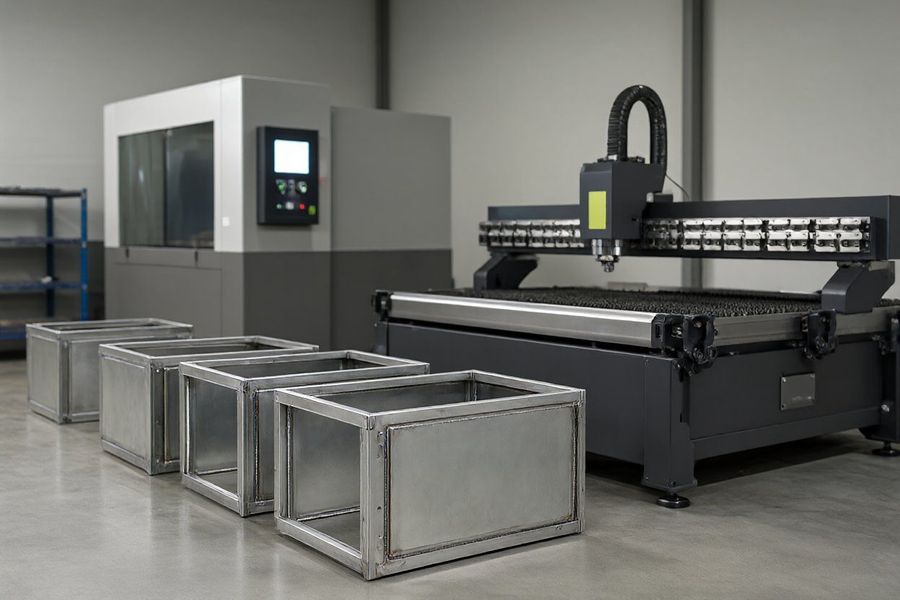
Two 6 kW fibre lasers at ±0.01 mm positioning cut profiles, openings and cut-outs straight from the drawing, with no tooling to amortise and no minimum quantity.
±0.01 mm · up to 12 mm · no tooling charge
 Request a quote ↗
CUSTOM ENCLOSURE MANUFACTURING
Laser cutting, CNC bending, welding, surface treatment, CNC stamping and CNC machined parts — the six steps a sheet metal enclosure actually passes through, each with its own page because each has its own limits.
3,000 mm working range · 1 piece minimum · ISO 9001
SIX PROCESSES
A drawing that cuts cleanly can still be impossible to bend. Each page below states the limits that process actually runs to, so a project can be ruled in or out before anyone quotes it.
01
Two 6 kW fibre lasers at ±0.01 mm positioning cut profiles, openings and cut-outs straight from the drawing, with no tooling to amortise and no minimum quantity.
±0.01 mm · up to 12 mm · no tooling charge
02
Press-brake forming to the approved geometry, with bend allowance confirmed on the first-off and the sequence planned so a bend is never blocked by one already made.
±0.1° on angle · 3,000 mm · 1 piece
03
Laser, TIG and MIG chosen by joint type and by what the visible face has to look like afterwards — structural strength and appearance are specified separately.
TIG · MIG · laser · weld finishing on request
04
Deburring, pretreatment and powder coating on our own line, plus mechanical finishes on stainless and aluminium where an applied coating is the wrong answer.
5 finishes · RAL / Pantone matched
05
CNC turret punching for repeat panels, mounting patterns and vent arrays, where the turret press is faster and cheaper per hole than the laser once the pattern repeats.
30 t turret · up to 6 mm · ±0.1 mm
06
Turned and milled components that bolt onto or into the enclosure — brackets, spacers, threaded inserts, busbars and heat-sink mounts, in aluminium and stainless.
±0.02 mm · 3-axis · from 1 piece
WHAT THE BRIEF HAS TO SETTLE
An enclosure is only correct in context. Before the first panel is cut, these five things have to be settled — and each one closes off a range of options.
If some of them are still open, send what you have. Engineering marks what is undecided and what each open item changes, so you close them once rather than discovering them at the installation.
Component dimensions, mounting pattern, heat load and the clearances a technician needs to service it.
Indoor or outdoor, dust and moisture, temperature range, chloride or chemical exposure, and any IP target you need to hold.
Overall dimensions, mounting method, door swing, cable entry side, lifting points and how the unit is handled when it arrives.
Grade selected against the exposure, plus colour, texture and the faces that will be judged visually.
Prototype, trial batch or repeat order — it decides the documentation depth, inspection scope and packing.
WORKING RANGE
These are the limits the process actually runs to. If your part falls outside them, send it anyway — we will review it and say plainly whether it is a fit.
Longest dimension in a single piece. Larger assemblies ship as bolt-together sections.
Carbon, galvanized, 304 and 316 stainless, aluminium.
Fibre laser at ±0.01 mm positioning, plus a 30 t CNC turret press.
Minimum order, no tooling charge. Prototype and volume share one process.
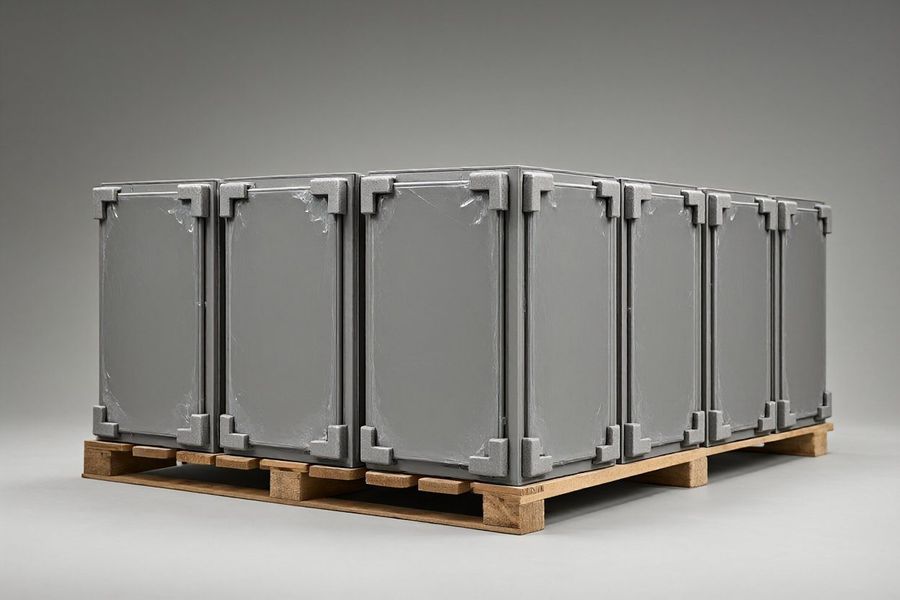
Finished units, protected and packed — the last step of the same process that started with a drawing.
HOW TO START
Four steps, each with something you can hold us to.
01
Drawings or dimensions, application, material, quantity and timing. Sign an NDA first if your policy needs one.
02
Manufacturability findings, open questions and the price, returned together.
03
A sample confirms dimensions, fit and finish before volume production starts.
04
Production, inspection report, export documents and shipment per EXW, FOB, CIF or DDP.
READY WHEN YOU ARE
Engineering reviews manufacturability and returns the open questions with the quotation — before you commit to production.
SEND DRAWINGS
Share the drawings or the dimensions you have. Engineering reviews them and returns the findings with the quotation — usually within one working day.