OEM sheet metal manufacturing · Dongguan, Chinasales01@xinghaoxin.comTalk to our team ↗
Medical Equipment Housings
CUSTOM XHX ENCLOSURE

Medical Equipment Housings

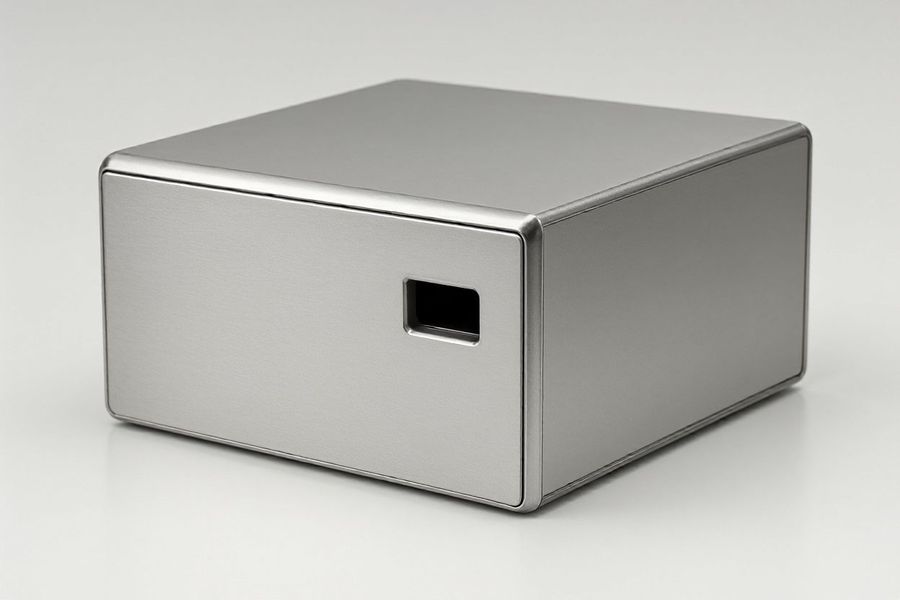
Stainless steel housings and structures for medical and laboratory equipment.

  • Free DFM review
  • From 1 piece
  • ISO 9001 quality system
  • Quote with findings

Built to your drawings · OEM / ODM · Dongguan, China

MEDICAL & LABORATORY ENCLOSURES

Specified for
cleanability first.

Medical and laboratory enclosures are specified for how they clean, not how they look. Surfaces have to withstand repeated cleaning agents, joints should not trap contamination, and the finish has to stay intact through years of wipe-down. That usually means stainless steel, and it means the fabrication detail matters as much as the material.

Cleaning regime drives the specification

The cleaning chemicals and frequency decide the grade and the finish. A enclosure wiped with a light disinfectant once a day is a different specification from one washed down with caustic agents every shift. We ask what it is cleaned with before recommending a material.

Joints that do not trap contamination

A crevice is where contamination survives a wipe-down. Continuous welds, finished where required, and corners formed without an open seam are what make a enclosure genuinely cleanable rather than just visually clean.

Fit to the equipment, not the shelf

These enclosures usually form part of a machine or a clinical environment, so dimensional accuracy against the equipment drawing is held to the same standard as the finish. A enclosure that fits badly is a hygiene problem as well as an assembly problem.

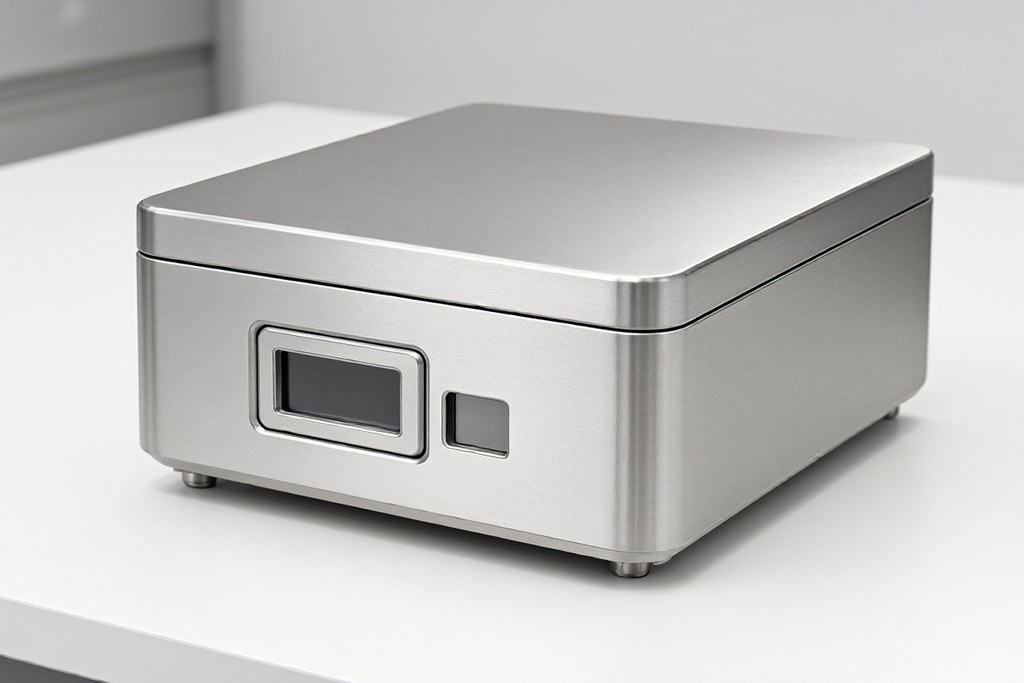
Brushed stainless steel medical equipment enclosure

MATERIAL SELECTION

Choosing the material
for the real exposure.

The grade is decided by where the enclosure lives and how it is cleaned — not by what is cheapest on the day.

304 stainless — general clinical and laboratory

Handles most clinical, laboratory and food-adjacent environments. Supplied brushed or abrasive-blasted, with welds finished on visible and cleanable surfaces.

Best for: general clinical, laboratory, food equipment

316 stainless — chlorides and harsh agents

The correct grade where saline, chlorinated disinfectants or harsh cleaning chemicals are used. Noticeably more expensive, so it is specified against the actual cleaning regime rather than as insurance.

Best for: saline environments, strong disinfection, marine-adjacent

Aluminium — lightweight equipment

Used where weight matters or where the enclosure is part of a portable device. Anodized for a durable surface that does not chip like paint.

Best for: portable equipment, imaging accessories, weight-limited mounts

Powder-coated steel — non-clinical support

Acceptable for equipment stands, trolleys and support structures that are not in the clean zone, where the cost of stainless cannot be justified.

Best for: equipment stands, non-clean-zone supports

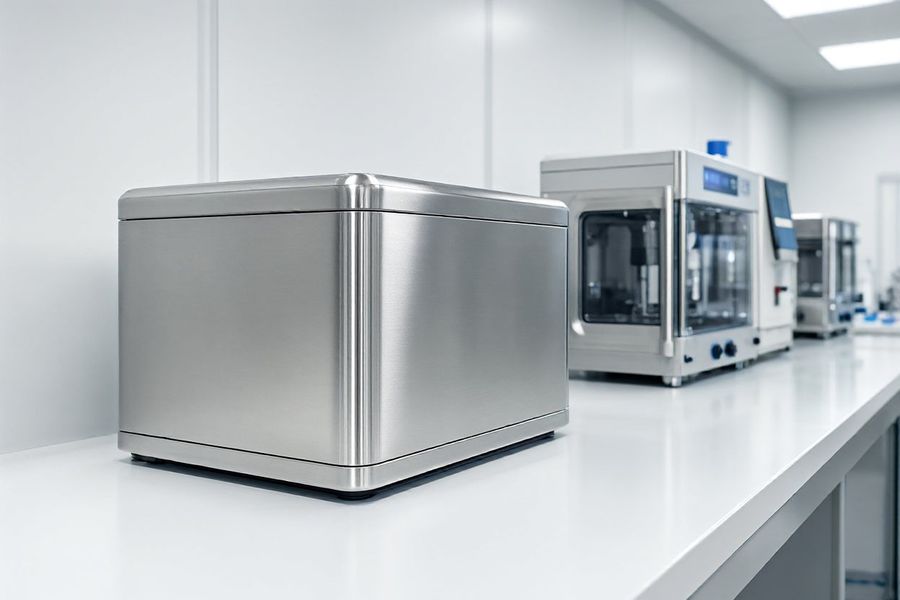
Stainless enclosure in a laboratory environment

From the workshop — the same drawing-led process on every build.

WHERE IT IS INSTALLED

Applications and
what drives each one.

The same product behaves differently depending on where it goes. These are the installations we build for and the constraint that shapes each.

01

Laboratory analytical equipment

Enclosures around spectrometers, analysers and sample handling systems. Cleanability and dimensional accuracy against the instrument both matter, and the enclosure often forms part of the product’s exterior.

02

Clinical and diagnostic equipment

Enclosures in patient-adjacent environments where wipe-down frequency is high and appearance is part of the product. Edge treatment matters because these are handled constantly.

03

Pharmaceutical production equipment

Wash-down environments with validated cleaning procedures. Crevice-free joints, documented material grades and material certificates are normal requirements rather than optional extras.

04

Cleanroom and containment enclosures

Frames and panels forming part of a controlled environment, where the joint detail and surface finish determine whether the space can be cleaned to specification.

QUESTIONS

What buyers ask
about this product.

304 or 316 stainless — which do I need?

304 covers most clinical and laboratory environments. 316 is the answer where chlorides, saline or strong disinfectants are used. Tell us what the enclosure is cleaned with and we recommend the grade rather than defaulting to the more expensive one.

Can you produce crevice-free welded joints?

Yes, with continuous welds finished where the cleaning regime requires it. Mark the surfaces that must be crevice-free on the drawing and the joint detail is specified accordingly.

Do you provide material certificates?

Yes. Material certificates travel with the order, along with the dimensional inspection report and certificate of origin.

Can you match the finish of existing equipment?

Send a sample of the finish you need to match, or specify brushed, abrasive-blasted or polished, and we match against it. Finish consistency across a batch is checked at first-off sample.

Are sharp edges a concern?

Deburring and edge finishing are standard on all parts. For enclosures that are handled constantly, we specify the edge treatment explicitly rather than relying on a general deburr.

START A PROJECT

Send the drawing.
Get the findings back.

Engineering reviews manufacturability and returns the open questions with the quotation — before you commit to production.