Galvanized steel with powder coat
The standard for outdoor street cabinets and remote enclosures. The zinc layer protects cut edges and the coating handles UV and rain.
Best for: street cabinets, remote outdoor locations
 Request a quote ↗
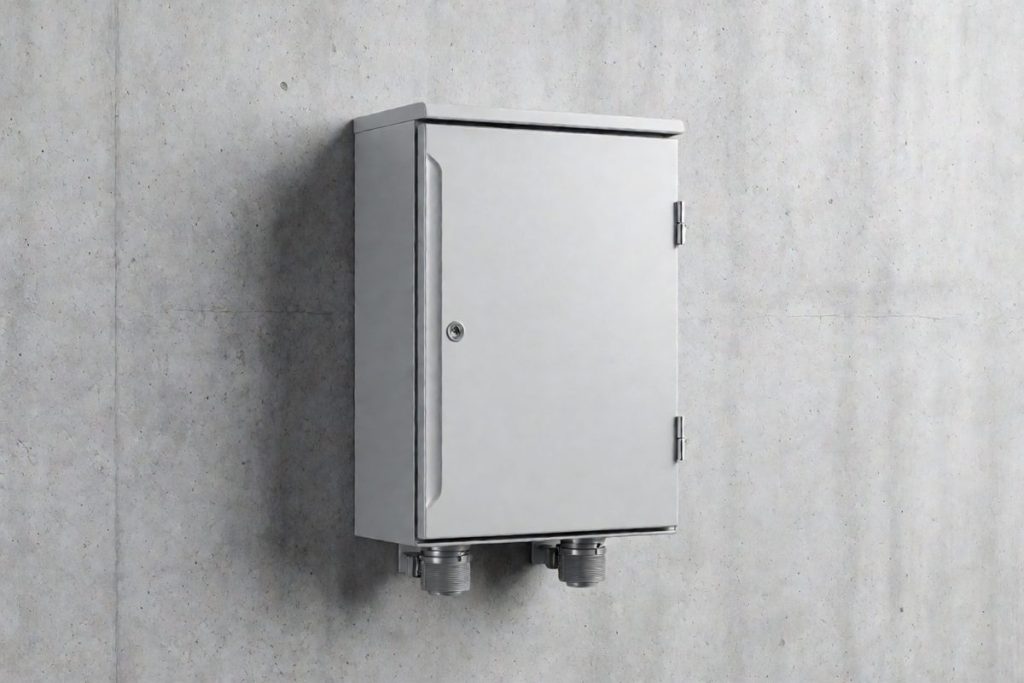
Communication cabinets, fibre distribution boxes and network device chassis.
Built to your drawings · OEM / ODM · Dongguan, China
TELECOM & NETWORK ENCLOSURES
Telecom and network enclosures are compact, lightly loaded and easy to underestimate. A 1U error in rail spacing, a gland in the wrong place or a door that will not stay open during a splice job turns a routine installation into a callout — and these cabinets are usually in places nobody visits.
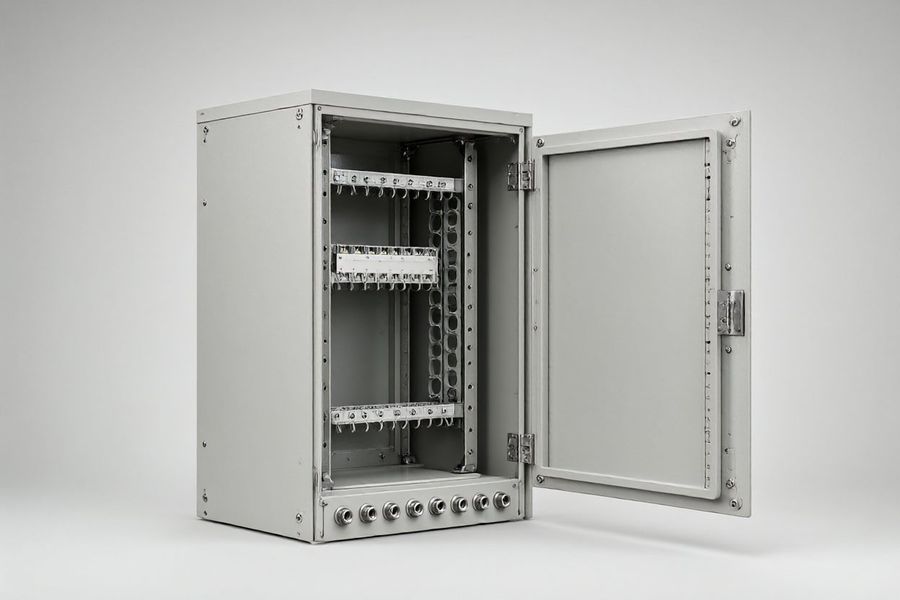
Network equipment is built to rack standards. If the rail positions and hole patterns do not match, the equipment does not mount. We build to the standard you name, or to the hole pattern you supply, and confirm it at first-off sample.
The internal depth of a fibre enclosure is set by the minimum bend radius of the cable, not by the equipment it holds. Cabling that is forced into too tight a radius loses performance, so internal depth and cable management are sized against the fibre types in use.
Many of these cabinets sit in street furniture, rooftop shelters or remote compounds and are opened rarely. Sealing, coating and door hardware are specified for that pattern of use rather than for an air-conditioned equipment room.
MATERIAL SELECTION
The grade is decided by where the enclosure lives and how it is cleaned — not by what is cheapest on the day.
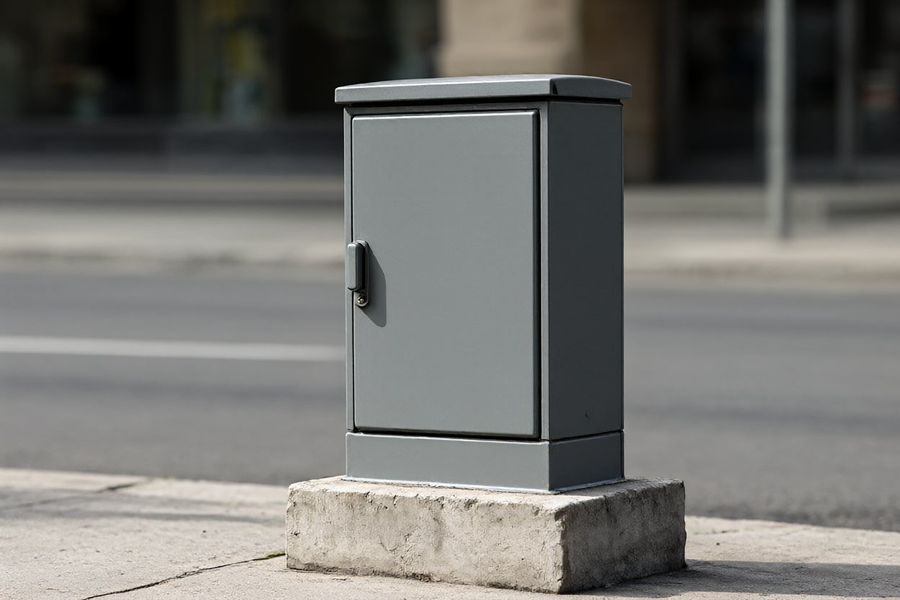
The standard for outdoor street cabinets and remote enclosures. The zinc layer protects cut edges and the coating handles UV and rain.
Best for: street cabinets, remote outdoor locations
Used for indoor rack and distribution enclosures where appearance and dimensional accuracy matter more than corrosion resistance.
Best for: indoor racks, equipment rooms, data closets
Specified for coastal and marine locations, and for wash-down or industrial corrosive environments. 316 where chlorides are present.
Best for: coastal, marine, industrial corrosive environments
Used for pole-mounted and rooftop units where the mounting structure or the installer cannot take the weight of a steel cabinet.
Best for: pole-mounted, rooftop, installer weight limits
From the workshop — the same drawing-led process on every build.
WHERE IT IS INSTALLED
The same product behaves differently depending on where it goes. These are the installations we build for and the constraint that shapes each.
01
Broadband and small-cell cabinets in public space. Vandal resistance, weather protection and a clean appearance matter; the cabinet is part of the streetscape and is occasionally treated accordingly.
02
Where splices are made and fibres are managed. Internal depth, tray layout and bend radius control dominate the design, and the door has to stay open while both hands are in use.
03
Cabinets on buildings or in equipment shelters, where access is awkward and the cabinet has to be carried up. Weight, lifting and the number of separate parts all matter.
04
Network equipment on a factory floor area, where dust, vibration and electromagnetic noise are the conditions. Sealing and bonding provisions are specified accordingly.
WHAT IS CHANGING
Design requirements in this category are moving. These are the shifts we see in drawings arriving today, and what each one does to the enclosure.
Compute is moving closer to the user, which puts servers into street and shelter cabinets. That adds heat load and weight to enclosures that were designed as passive splice boxes, and thermal management follows.
More, smaller radio locations mean more cabinets in more places, often with less planning time per location. Standardised, quickly deployable enclosures are replacing bespoke designs.
More fibres per cable and per enclosure means tighter cable management and more attention to bend radius. Internal layout is becoming the constraint rather than the outer size.
Local authorities increasingly specify the appearance of street cabinets. Colour, finish and even shape are becoming planning requirements, not just branding choices.
QUESTIONS
Yes. Tell us the standard, or give us the rail hole pattern, and the enclosure is built to match and verified at first-off sample.
Yes — wall, pole, rack and floor-standing are all fabricated on the same process. Pole brackets can be included in the scope.
Give us the cable types and the routing you need and we size the internal depth and cable management to suit. Undersizing this is the most common cause of performance problems in fibre enclosures.
With the right sealing and coating for the environment, yes. Tell us the installation conditions so the specification matches rather than defaults.
Yes. Rails, tray, cable management and earth bars can be fitted before shipping, so the installer only has to mount the cabinet and pull cable.
START A PROJECT
Engineering reviews manufacturability and returns the open questions with the quotation — before you commit to production.
SEND DRAWINGS
Share the drawings or the dimensions you have. Engineering reviews them and returns the findings with the quotation — usually within one working day.