OEM sheet metal manufacturing · Dongguan, Chinasales01@xinghaoxin.comTalk to our team ↗
Battery Energy Storage Cabinets
CUSTOM XHX ENCLOSURE

Battery Energy Storage Cabinets

Outdoor cabinet structures for BESS and commercial energy storage systems.

  • Free DFM review
  • From 1 piece
  • ISO 9001 quality system
  • Quote with findings

Built to your drawings · OEM / ODM · Dongguan, China

BESS CABINET ENCLOSURES

The largest structures
we build.

Battery energy storage system cabinets are the biggest and least forgiving enclosures we make. They carry a dense load, generate heat continuously, sit outdoors for decades, and are often installed where a service visit takes planning. Structure, thermal design and coating all have to be right the first time.

A building for equipment

At this size the enclosure stops being a box and becomes a small building. It has a load path from the modules down to the base, a thermal strategy, an access strategy and a transport strategy. Each one is decided separately and then reconciled.

Container limits shape the design

A BESS unit that will not fit a shipping container is a transport problem before it is an engineering problem. Where the finished size exceeds container dimensions, we design bolt-together sections so the unit ships within limits and assembles rigidly during installation, with rack alignment preserved across the joints.

Thermal design is not optional

Storage systems run continuously. The ventilation, fan or heat-exchanger provision has to be sized to the real duty cycle and shown on the drawing, so the cooling strategy can be checked before metal is cut.

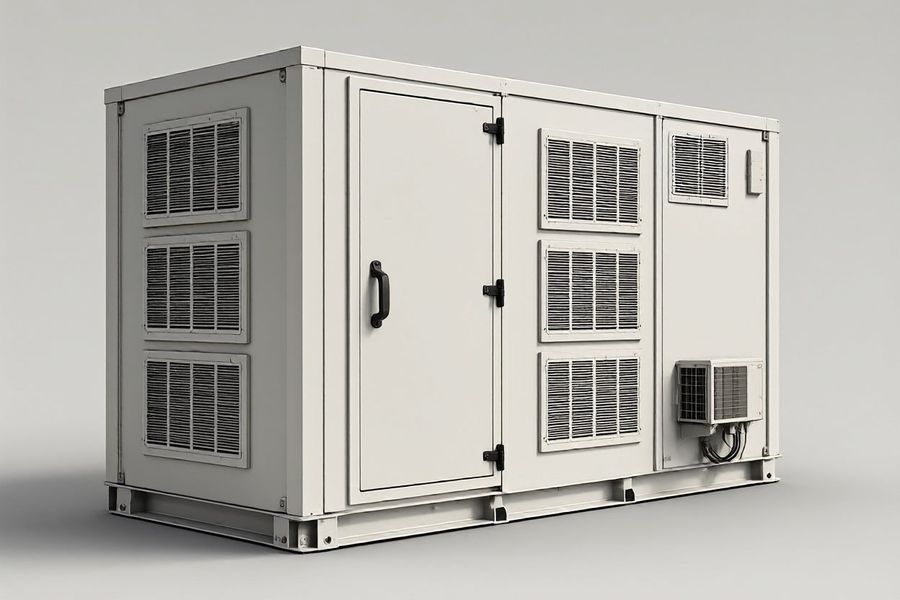
Large BESS cabinet with ventilation and HVAC unit

MATERIAL SELECTION

Choosing the material
for the real exposure.

The grade is decided by where the enclosure lives and how it is cleaned — not by what is cheapest on the day.

Carbon steel with a heavy coating system

The normal choice for inland locations: structural, weldable and economic at this size. The coating is treated as a system — substrate preparation plus a specified coating thickness — because a BESS cabinet is expected to stay outdoors for its whole service life.

Best for: inland locations, sheltered yards, factory yards

Galvanized steel

Used where the cabinet may be modified during installation or where the internal environment is damp. The zinc layer protects the frame interior and any cut edges.

Best for: damp climates, field-modified units

304 / 316 stainless

Specified for coastal and marine installations. 316 where salt spray reaches the cabinet. At BESS sizes this is a significant cost, so the grade is chosen against a measured exposure rather than added as margin.

Best for: coastal, marine, industrial corrosive environments

Aluminium for weight-critical transport

Occasionally used where transport weight is the binding constraint. The frame design changes to recover the stiffness lost to the lighter material.

Best for: weight-limited transport, rooftop installations

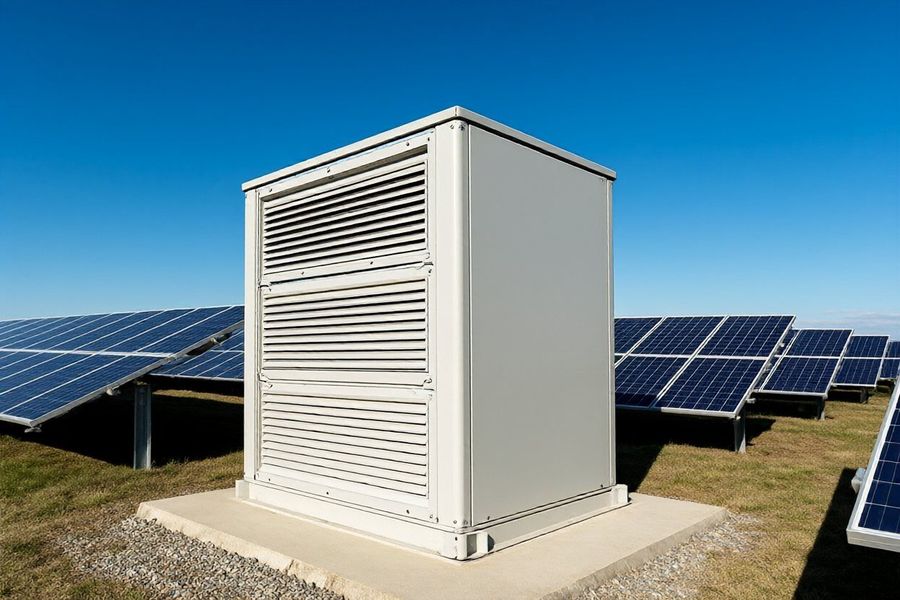
BESS cabinet installed at a solar farm

From the workshop — the same drawing-led process on every build.

WHERE IT IS INSTALLED

Applications and
what drives each one.

The same product behaves differently depending on where it goes. These are the installations we build for and the constraint that shapes each.

01

Utility-scale co-located storage

Storage beside a generation facility, installed in an outdoor compound and inspected on a schedule. Transport size, lifting points and the thermal strategy dominate the design.

02

Commercial and industrial peak shaving

Storage in a factory or campus yard, where the cabinet is close to buildings. Fire strategy and separation distances become design inputs, affecting compartment boundaries and venting.

03

Grid support and frequency response

Fast-response installations where the equipment cycles hard. Thermal design has to handle repeated high-rate cycles rather than steady operation.

04

Microgrid and off-grid locations

Remote installations where a service visit is expensive. Access, module replacement and connector accessibility are prioritised over compactness.

QUESTIONS

What buyers ask
about this product.

Can you build a cabinet larger than 3,000 mm?

The single-piece limit is 3,000 mm on the longest dimension. Larger systems are built as bolt-together sections that assemble during installation — tell us the overall size and we work out the section split with you.

How is the loaded weight handled?

Give us the module weight and stack height. Base, frame and rack supports are sized to the loaded weight, with lifting points designed into the structure so the load does not travel through the panels.

Do you supply fire suppression or thermal equipment?

We fabricate the provisions — mounting points, penetrations, vent openings and duct flanges. The suppression and thermal equipment itself is supplied to your specification.

What coating suits a coastal installation?

For salt air, 316 stainless or a coating system specified for that exposure. Tell us the installation conditions and we recommend the grade rather than defaulting to the cheapest option.

How is alignment kept across section joints?

The joints are designed with locating features and the sections are built on a jig, so the rack positions line up when the unit is assembled. The first-off sample confirms alignment before the batch runs.

START A PROJECT

Send the drawing.
Get the findings back.

Engineering reviews manufacturability and returns the open questions with the quotation — before you commit to production.